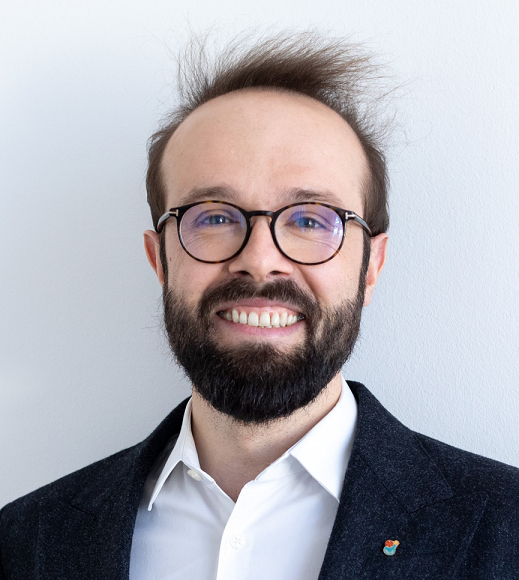
About
Cristian Axenie is Professor of Artificial Intelligence founded by the High Tech Agenda Bayern and Research Group Leader of SPICES Lab at the Technische Hochschule Nürnberg Georg Simon Ohm in Nürnberg, Germany. At the same time, Dr Axenie is Group Leader of the Neuromorphic Computing Solutions Team at the Fraunhofer Institute for Integrated Circuits (IIS), funded by a prestigious Attract Research Grant.
Cristian Axenie is a Steering Committee Member of the AI Impact Initiative, AI4GOOD of the International Telecommunications Union (ITU) and United Nations (UN). At the same time, he is Member of the Open Neuromorphic Community, Member of the Green Software Foundation and the Free Software Foundation #4900, Invited Speaker of the Alan Turing Institute in the UK, and Member of the AI Commons Working Group at Centre Leo Apostel (CLEA), Vrije Universiteit Brussel (VUB) supporting the awareness, acceptance, and adoption of neuromorphic AI technologies in the industrial context and their impact. Additionally, Cristian Axenie is a Senior Member of IEEE and serves as Group Leader of the Applied Antifragility Research Group and as a Board Member of Neuromorphic Computing Labs of Northern Bavaria.
After earning a Dr.Eng.Sc. in Neuroscience and Robotics from Technical University of Munich (TUM), Dr Axenie was Research Fellow in Neuromorphic Engineering with the TUM Center of Competence Neuroengineering before joining Huawei Research Centre in Munich. With Huawei, Dr Axenie was Staff Research Engineer in Enterprise Intelligence for Cloud Solutions with Huawei’s largest research centre outside China. At the same time, Dr Axenie was Head of the Laboratory and Principal Scientist at the AUDI Konfuzius-Institut Ingolstadt Laboratory at Technische Hochschule Ingolstadt (THI), a Sino-German research initiative focused on Human-centred and Embodied Artificial Intelligence. Dr Axenie teaches Neuromorphic Engineering, TinyML, and Data Fusion every term for Computer Science undergrads. Earlier, Dr Axenie earned a B.Sc. in Control Engineering and a M.Sc. in Robotics and AI from University of Lower Danube in Galati in Romania.
Cristian Axenie is Professor of AI and a seasoned researcher with 15+ years of academic research and 10+ years of industrial research experience. His research was disseminated in 50+ peer-reviewed publications and 10+ patents. He is not only pushing the boundaries of industrial and social technology awareness, dialogue, and adoption.
Research portfolio with applications
Dr Axenie’s research agenda centres on efficient artificial intelligence techniques and systems for TinyML and Neuromorphic Engineering systems design. More precisely, Dr Axenie is combining mathematical modelling, control theory, data fusion, machine learning, and simulation to design, implement, and deploy efficient intelligent embedded and edge compute systems across domains.
